West Bengal needs 2 points extra annual growth to close income gap by 2036, panel says
At an Economic Times event, business leaders said the state must build a modern economic identity, create better jobs and use its MSME base to keep young talent at home.
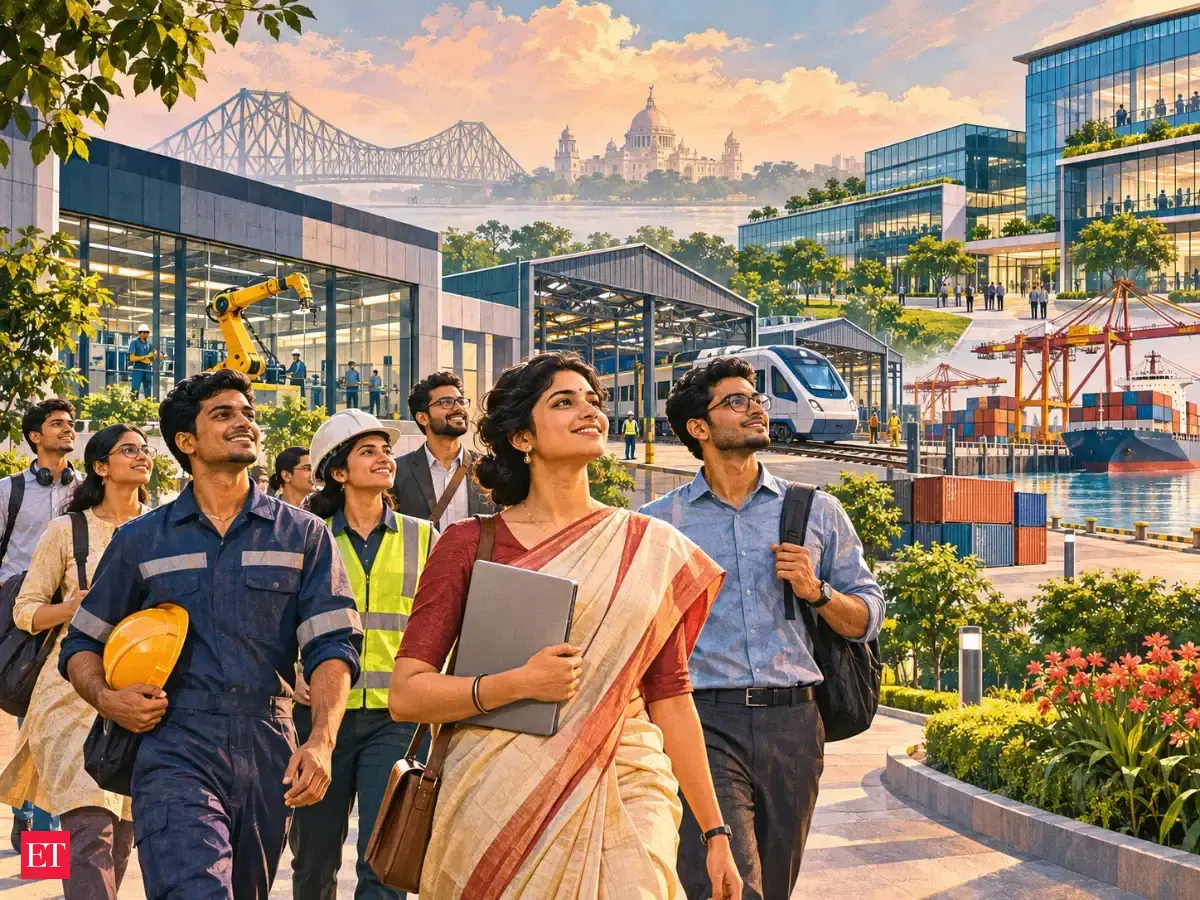
West Bengal would have to grow two percentage points faster than the national average every year to close its per capita income gap by 2036, Arrjavv director Diva Jain said at The Economic Times Bengal Ascends event. She put the state's per capita income at about 16% below the national average.
Jain was speaking on a panel titled "Imagining the Bengal of Tomorrow". The other speakers were Suvankar Sen of Senco Gold and Diamonds, Vibhash Agarwal of Emami Agrotech and Prithish Chowdhary of Titagarh Rail Systems. Their shared message was that the state cannot rely on nostalgia. It needs an economy that gives young people reasons to stay, lets professionals return and attracts investors.
Jain said Bengal lacks a clear economic identity. She noted that other big states are linked in the public mind with a sector: finance, enterprise, manufacturing or technology. Bengal, she said, is still associated mainly with its past. If professionals are to come back, she argued, the state must close the pay gap with other states, widen career progression and narrow the investment gap. "Ecosystems develop where there is investment," she said.
Sen, however, said Bengal's heritage should not be written off. He described it as a value system built on creativity, freedom and unconventional thinking, drawing on the state's role in the freedom movement, philosophy and science. He said that value system should be linked to the new generation, and that openness to modern thinking and change had been missing in recent years.
Agarwal focused on jobs. He said opportunities in consulting, finance, marketing and agency work had grown faster in Mumbai and Delhi. Building comparable options in Bengal, he said, could help reverse the outflow of young talent.
Chowdhary pointed to the state's large base of micro, small and medium enterprises as a lever. He said it could be used to train workers and plug them into larger supply chains. He urged companies to work with industrial training institutes and invest in upskilling. He also acknowledged that not every person a company trains will stay with it.
The panel also cited the video game GTA 6 as an example of Bengal overlooking its current talent. Attention in the state went largely to Rupa Biswas, whose 1982 disco song features in the game. Far less went to Devanjana Talukdar, Abhijit Bose, Abhijit Ghosal and Devojit Nandi, who were part of its animation team.