Rao, Kesri, Mukherjee: How Congress's Contested Past Clashes With Its Autobiographies
A critical commentary argues that a recent memoir's claim that no injustice was done sits poorly with well-documented episodes involving three former Congress leaders.
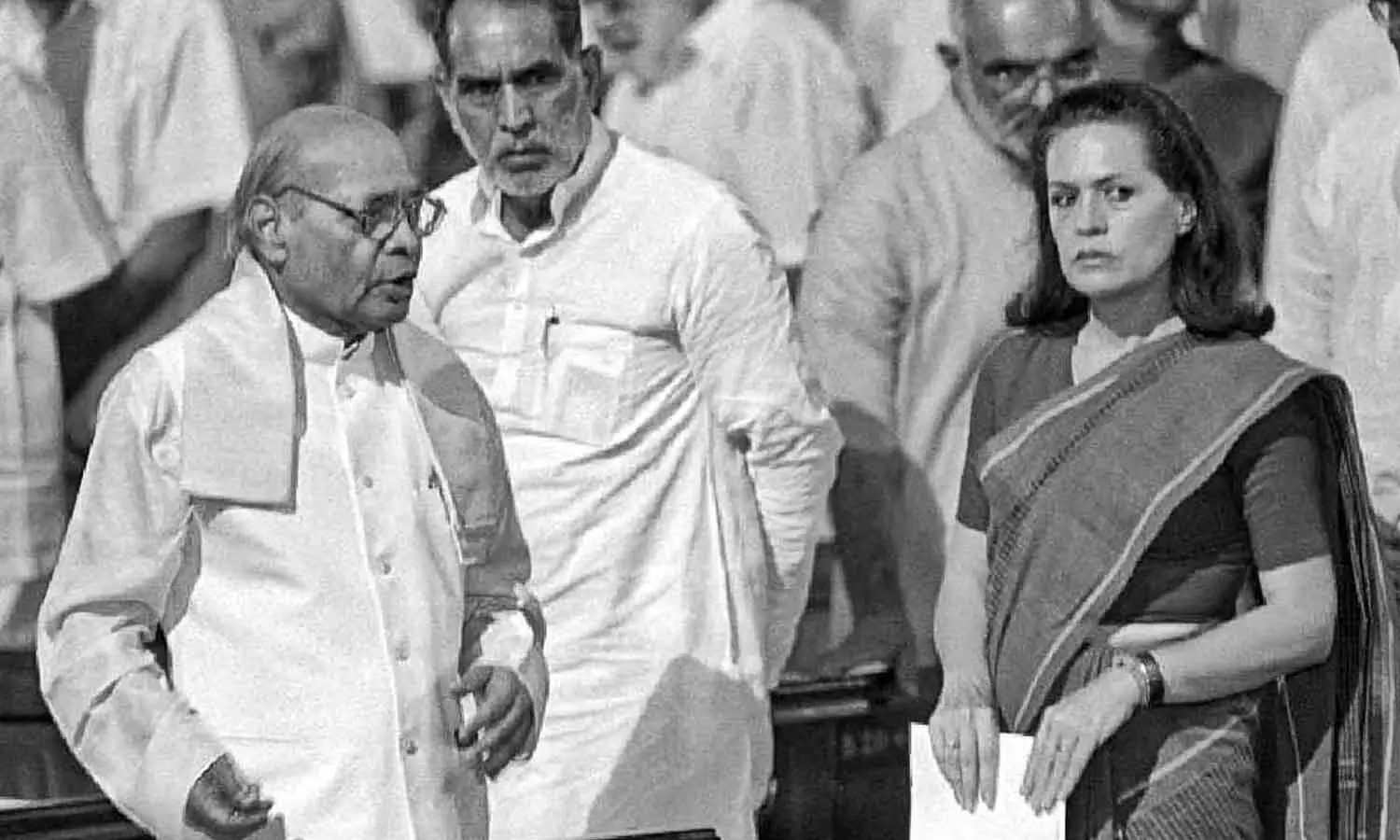
A commentary published in The Hans India takes aim at an autobiography whose author maintains that no injustice was done to anyone, arguing that the claim does not survive scrutiny of the party's own history. The piece uses the treatment of former Prime Minister P V Narasimha Rao, former party president Sitaram Kesri and former President Pranab Mukherjee as its test cases, framing them as evidence that internal conduct within the Congress has repeatedly fallen short of its stated values.
The argument turns first on Rao. Critics, as the piece notes, have long cited the blame placed on him for the party's electoral defeat and the isolation that followed as signs of political vindictiveness. The commentary links that isolation to a broader concern: that a leader of Rao's stature was pushed aside to protect the dominance of one family. The most emotive episode it describes is the reported refusal to bring Rao's mortal remains into the party headquarters in Delhi, with the gates closed. The author presents that incident as a question about what the party's leadership believed dignity required, and why a former Prime Minister and party president was denied it.
The Kesri episode is treated in similar terms. The commentary describes his removal as party president, allegedly carried out abruptly and humiliatingly from the AICC headquarters, as one of the most contested moments in the party's recent past. It also points to a tension between Congress's public emphasis on social justice and the treatment of a senior leader from a Dalit background, noting that the family has never openly acknowledged responsibility for the humiliation he is said to have suffered. The piece is careful to frame these as allegations, but it treats the silence as itself significant.
Mukherjee's case is presented as a matter of merit. The commentary describes him as a leader with deep knowledge of the economy and national affairs, and says critics argue he was passed over for the prime ministership because he was seen as insufficiently pliable to family interests. Taken together with the Rao and Kesri episodes, the piece argues that a pattern emerges in which loyalty is rewarded over competence, and in which the perception that family interests outweighed national ones has fed accusations of undemocratic conduct.
The commentary also widens its frame to internal democracy more generally. It describes intra-party democracy in Congress as having for decades been more a decorative phrase than a working practice, and it connects the concentration of power around one family to the sidelining of talented senior figures. It also references debate over who wielded influence during Manmohan Singh's tenure as Prime Minister, citing Sanjay Baru's book The Accidental Prime Minister as having drawn attention to that question.
Why the argument matters is less about any single episode than about how parties narrate their own histories. Autobiographies by political figures often serve as official memory, and a memoir that dismisses allegations of injustice shapes how younger party members and voters understand past conflicts. The commentary's central claim, that such accounts cannot be read as introspection when the record is contested, is a point that goes beyond Congress. It is a reminder that the credibility of political memoirs rests on how they engage with uncomfortable episodes, not only on how they describe the author's achievements.
Readers can review the full commentary at The Hans India.