Manila summits: Quad calls out China's export curbs as India eyes ASEAN trade fix
The Quad's first leaders' meeting in two years named economic coercion as a concern, while India's stalled trade pact with ASEAN shows how much harder the economic half of the Indo-Pacific story is.
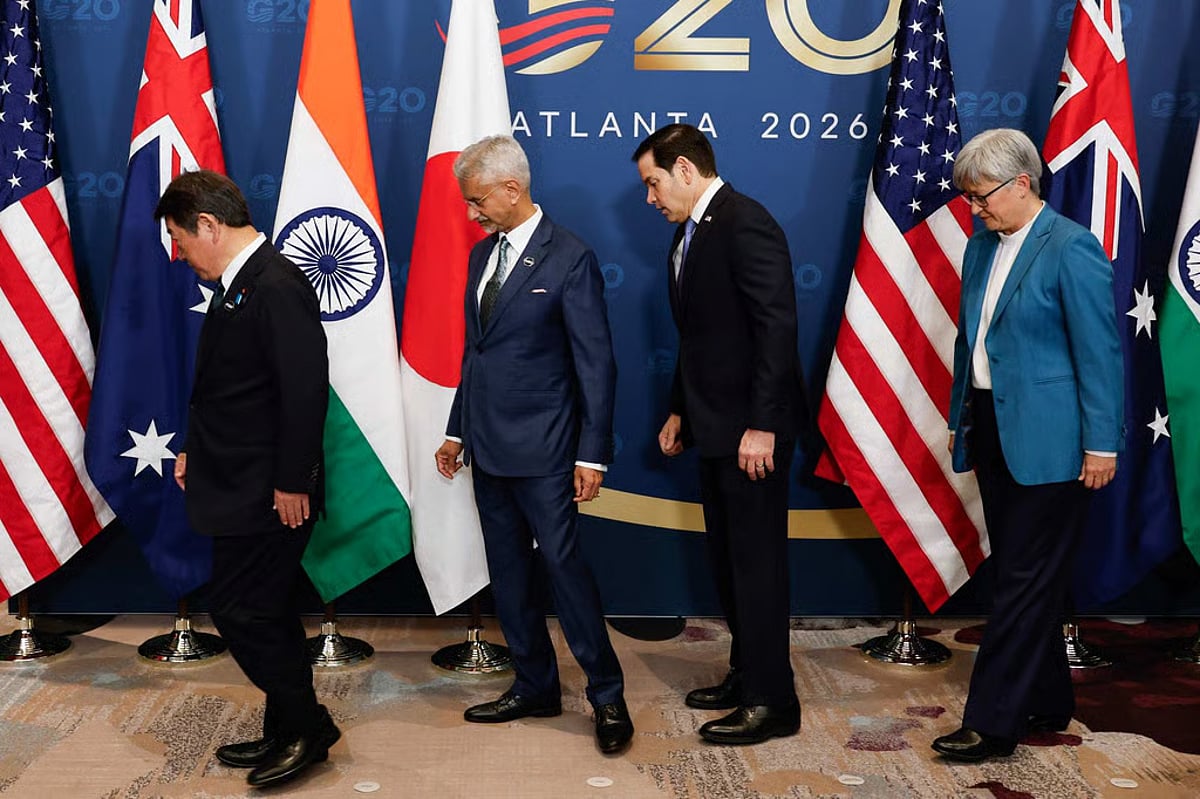
Quad leaders from the US, Japan, Australia and India met in Manila on the first two days of this week, their first summit after a gap of two years, and issued a communiqué voicing "grave concerns about economic coercion, including through arbitrary export restrictions". China was not named in that line, but nobody in the room needed a map. The target was Beijing's grip on critical minerals, which it has used as leverage against American tariffs and technology export curbs.
The group also pledged closer work on maritime surveillance, artificial intelligence, energy and cybersecurity. The agenda owes less to the leaders, who skipped their own summit for two years, than to the four foreign ministers. They met repeatedly in the interim to trim the Quad's themes into something that could survive a leaders' calendar. It is the diplomatic equivalent of keeping the lights on in an empty house.
The wider Manila circuit showed the limits of a China-centred pitch. Washington tends to view the Quad through strategic competition with Beijing. ASEAN, the 11-member bloc headquartered in Jakarta, has no appetite for being asked to pick a side. India did sign a disaster response and early warning pact with the grouping, a useful but low-voltage deliverable.
The louder silence concerned trade. Commerce between ASEAN and India has grown only tepidly, and China's shadow falls here too. Worries about rules of origin persist, in particular that Chinese-made goods could gain preferential access after minimal processing in a third territory. A trade pact that can be gamed that way is one that Delhi's negotiators will keep arguing over.
The diplomatic caravan now moves to Shenzhen for the APEC Summit and the first China-Russia-US trilateral. That raises the prospect of a G3 of the three military superpowers, even if only temporary and tactical. For India, such a format would add unpredictability to a region already short of predictability.
The policy takeaway is plain. India needs to break the deadlock on concluding its free trade agreement with ASEAN and offer members better market access, investment, technology and dependable maritime partnership. Trade routes, supply chains and technology sit on the same security map that Delhi studies with its Quad partners, so treating them as separate files is a luxury it cannot afford.
Finally, the Quad's prominence tends to track the mood of its most powerful member, the US. India's safer course is to deepen ties with Japan and Australia regardless, since bilateral relationships hold their value whatever shape the next world order takes. The original editorial is available at The New Indian Express.