Gurgaon groundwater recovery stalls in 2026 after three years of rain-fed gains
The district's pre-monsoon water table held at about 30.5 metres in June, a sign that two years of heavy rain bought time but did not fix over-extraction.
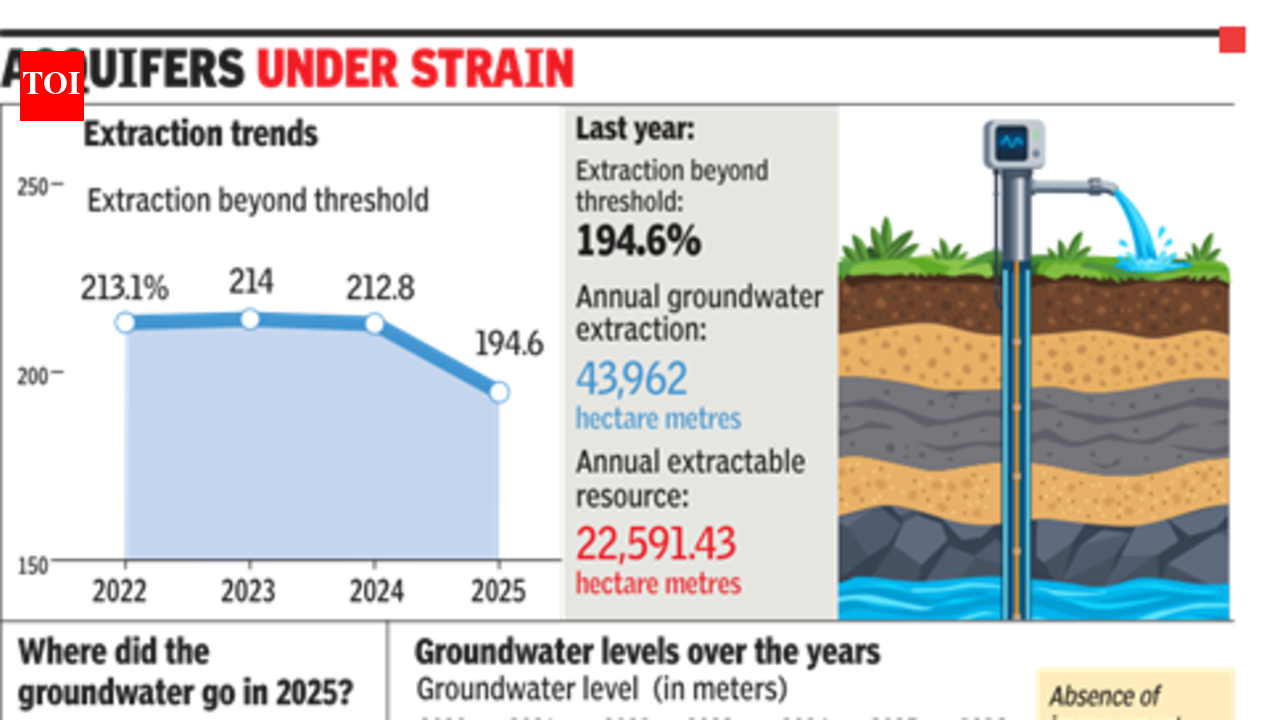
Gurgaon's groundwater recovery has stalled. The district's average pre-monsoon water level in June 2026 was 30.5 metres below ground, against 30.6 metres a year earlier, according to data from the district groundwater cell. The reading covers 62 monitoring locations across four blocks. It shows that the city has kept the gains of the past three years but has not added to them.
The longer series explains why the plateau matters. The pre-monsoon level stood at 33.2 metres in 2018, then fell steadily to 35.8 metres in 2019, 36.2 in 2020, 36.9 in 2021 and 37.7 in 2022. It turned in 2023 at 37.3 metres, improved to 33.7 in 2024 and reached 30.6 in 2025, the shallowest in nearly a decade. The 2026 reading effectively holds that position.
The turnaround coincided with unusually heavy monsoon rainfall in 2024 and 2025. Experts had warned that the improvement owed more to weather than to any structural change in how Gurgaon draws and replenishes its groundwater. A senior hydrologist at Haryana's groundwater cell told the Times of India that rain-driven gains alone may not reverse the long-term strain on aquifers. In the hydrologist's reading, the lack of further improvement this year shows extraction still exceeds assessed replenishment.
Official assessments support that view. Gurgaon has been classified as an overexploited assessment unit since 2013. A government assessment cited in last year's report found that the city extracted about 43,262 hectare metres of groundwater in 2024, against a recharge capacity of roughly 20,333 hectare metres. That is 212% of the permissible annual limit. Only Kurukshetra and Panipat ranked worse in Haryana.
Researchers point to demand and governance as the underlying problem. Nitin Bassi, a fellow at the Council on Energy, Environment and Water, said demand across the National Capital Region keeps growing. He added that private control over groundwater and subsidised power encourage excessive and inefficient use. Manish Kumar of the Center for Study of Science, Technology and Policy said dense urbanisation, complex hydrogeology and shifting rainfall patterns make recovery in the region hard.
Kumar proposed a framework of four steps. The first is to cut extraction by regulating new borewells in over-extracted areas, including the south and southwest. The second is to enforce and audit rainwater harvesting in large buildings, housing societies, institutions and industries. The third is to reuse treated wastewater, with zero discharge expected from large users. The fourth is to recharge shallow aquifers by reviving natural drainage, lakes and ponds and by protecting recharge zones such as the Yamuna floodplains. He also called for greater urban permeability through measures such as bioswales and permeable pavements.
For policymakers, the 2026 data is a warning against reading two good monsoons as a lasting fix. With extraction at about twice the sustainable level, the water table will depend on rainfall until borewell regulation, recharge infrastructure and power pricing change how the resource is used. The coming monsoon will show whether the plateau holds or the district starts to lose its gains.