Chandrayaan-3 Vikram lander finds three soil layers within 10 cm of Moon surface
Indian scientists say temperature readings at Shiv Shakti Point reveal fine-scale layering that could guide future lunar habitats and water studies.
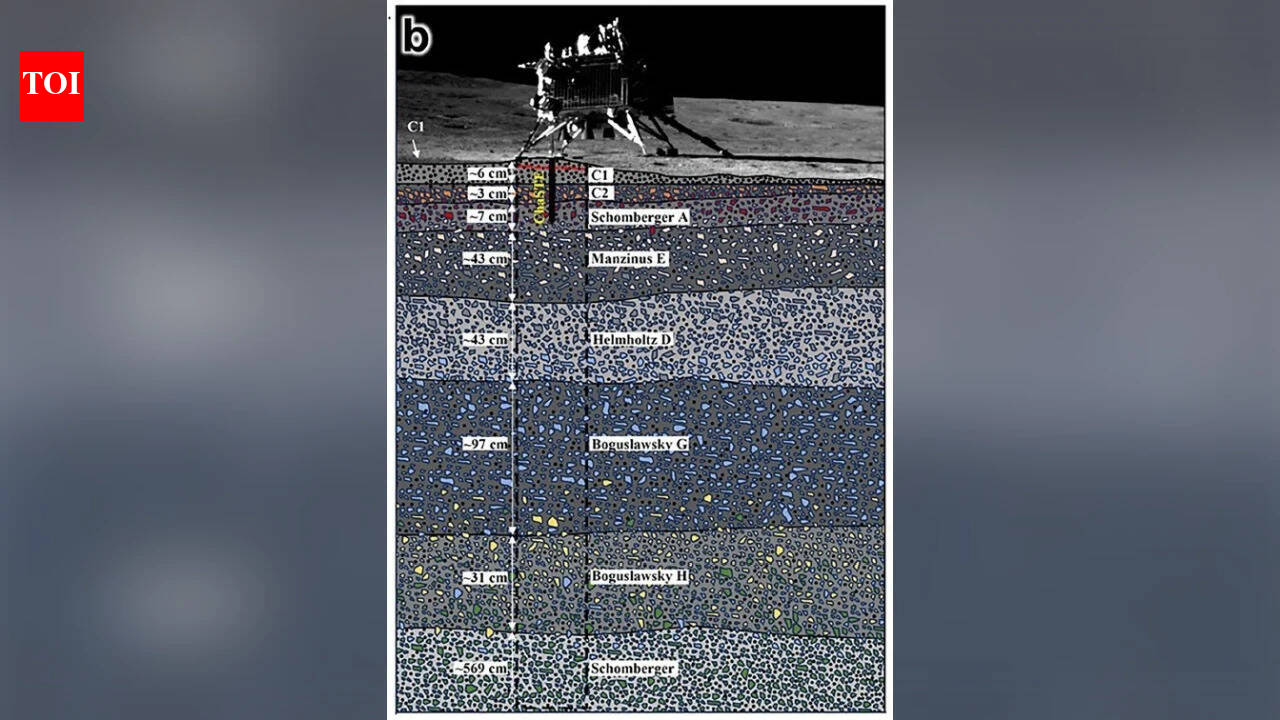
Data from India's Chandrayaan-3 Vikram lander has revealed three distinct layers within just 10 cm of lunar soil at Shiv Shakti Point, according to a study published in the Nature Portfolio journal npj Space Exploration. The layers differ in both physical and thermal properties.
The work, led by K Durga Prasad of the Physical Research Laboratory in Ahmedabad, draws on readings from the Chandra's Surface Thermophysical Experiment (ChaSTE). It describes a highly porous top layer reaching about 3 cm, a middle layer from 3 to 6 cm with higher thermal conductivity, and a denser lower layer from 6 to 10 cm with intermediate conductivity.
The team noted that the regolith is not uniform even in the top 10 centimetres, and that such fine-scale layering was neither observed nor expected earlier. The topmost soil has an estimated porosity of about 80% and a bulk density near 600 kg per cubic metre, rising to about 1,500 kg per cubic metre at 10 cm. Cohesion climbs to roughly 1,350 pascals at that depth, higher than estimates from earlier lunar missions.
The result builds on the team's April study, which examined measurements taken after Vikram's hop manoeuvre. The engine firing had disturbed the top 2-3 cm at the new site, exposing a two-layer structure. Analysis of data from the original landing spot now completes the three-layer picture, including the very porous surface layer.
The study offers the first direct thermophysical profiling of the Moon's southern high-latitude region. At local noon, the researchers recorded a temperature gradient of about 73 kelvin across the top 10 cm, with each layer responding differently to solar heating. They suggest that successive impacts from nearby craters, including Schomberger A, C2 and C1, may have laid down material of differing properties, an interpretation based on modelling and terrain analysis.
The findings carry practical weight. Porosity and conductivity of shallow soil can influence whether subsurface water is retained or lost through sublimation, and the researchers say retention could vary significantly from site to site. Temperature profiles may also help engineers choose depths for habitats and equipment, potentially reducing the need for active thermal management, and the data give future missions a ground-truth reference.